DC’s Comp Plan Status Quo Bias against Black Families & Racial Equity I


In 2001, former Control Board Chairman Alice Rivlin wrote an OP-ED (see below) entitled, “In the District of Columbia: Families vs. Singles, Cost vs. Benefits” arguing that Black Families were incapable of contributing to a future DC that was economically viable and socially vibrant.  According to Rivlin, White adult singles and couples were only person with this capacity.  In 2003, Mayor Williams would make this thinking official public policy ignoring the risks of displacement and .   As we saw with the Council’s first reading vote on the Comp Plan, our city’s thinking remains captive to this bias against Black Families despite the warnings of the CORE report.


Approximately a year after Rivlin’s OP-ED in 2002, OP would release the Social Compact Drilldown report fundamentally challenging and contradicting Rivlin’s thinking.  The Drilldown report found that Black and Brown families were more than able to contribute economically to the city’s future.  As well, census data was undercounting Black and Brown populations by as much as 30% in areas such as Columbia Heights.  In fact, the city used the Drilldown report findings to help convince Target and other retails to move to Columbia Heights a first nationwide.    The report also showed that Black and Brown Families had used DC’s rowhouse infrastructure as a means to achieve Racial Equity in our city.  As well, the study led to provisions being added to the 2006 Comp Plan to protect rowhouse neighborhoods as a commitment to Racial Equity.


Much of the tortured narrative we’ve heard from the Council and Executive agencies on the Comp Plan and the CORE report has been to protect the Rivlin narrative upon which Racial Equities have been build in our city over the last 20 years have been built and justified.   As the CORE pointed out, the city wishes to use Race Neutral policies such as the increased density of upFLUMing to address Racial Equities or like with the Nadeau amendments deflect our attention to the 1950s and 60s.   Others use narratives of “Developer Freehand vs. Development Constraint/Balance”, guard rails the need to respond to booming growth, vs. taking on the flaws of the Rivlin narrative, our Status Quo of Racial Inequity and Displace when it comes to Black and Brown families.


In 2001, Rivlin envisioned at city of 672,000 by 2010.   It took an additional 10 years until 2020 to reach this mark with 689,545.   Also, during this period Black income growth remained flat with the Black-White wealth gap increasing to one of the largest in the nation.  Ward 1 alone lost between 30,000 and 40,000 Black residents.  This is the status quo of Racial Equity that CORE flagged in evaluating our Comp Plan and many are seeking to dismiss.


It is likely most Council members are not familiar with Rivlin’s racially  biased, “In the District of Columbia: Families vs. Singles, Cost vs. Benefits” thinking toward the Black Family and how it became public policy.  Only Chairman Mendelson remains serving as an elected official from is period.  Although, CM Gray would arrive as this Rivlin-ism became the law of the land and CM Bonds served in the Williams administration at this time.  Many other policy makers such as Nadeau, Allen, Pinto, Trueblood, Falcicchio and others who have benefited from Rivlin’s thinking made public policy have yet to come to grips that Racial Equities of the status quo are on their watch as well.


Our public policy is Racially Biased against the Black Family and it must be addressed now!  Now with sound policy, not pie-in-the-sky density schemes.


William 


 ————————————————————————————————————————————

OP-ED
In the District of Columbia: Families vs. Singles, Cost vs. Benefits
Alice M. Rivlin and Carol O’CleireacainSunday, July 1, 2001


n an attempt to stimulate debate on the future of the District of Columbia and on its role in the Greater Washington area, we have set out a bold vision for the economic development and fiscal viability of the city over the next 10 years. In 2010, we imagine a city that is more densely settled, with a population of about 672,000—an increase of 100,000 residents over 2000, including substantially more families with children.


This is an ambitious goal, but we think it is both desirable and feasible. The District’s special status as the nation’s capital narrows its tax base drastically and prevents it from taxing the incomes of non-residents who work here. Aside from obtaining a larger contribution from the federal government—a goal we support—the District’s only option for improving its schools, roads and other public services is attracting and retaining more employed residents in Washington—a city, remember, that only 30 years ago was home to 750,000 people.


The question we address here is: Who should the additional residents be? We describe two different strategies and speculate about how the city would change if each were successful. The point is not to choose one or the other—we need both—but to understand where policy choices might lead.


Suppose the city tried to increase its population of adults with moderately good incomes and without school-age children by making it more attractive for those with jobs in the city to live in the District, rather than in the suburbs. This strategy would focus on young professionals, as well as some older adults, including empty-nesters and retirees. These are people enthusiastic about the city’s cultural amenities, restaurants, nightlife and diversity, but who also want safety, attractive surroundings and a well-managed government.


This strategy would require accelerating the development of middle-income and upscale housing that is already occurring in parts of Washington, and that could occur in reviving neighborhoods, eventually including the newly reclaimed Anacostia waterfront. Policies conducive to this would include: facilitating faster development of market-rate housing by streamlining the zoning processes; assisting developers in assembling packages of land for multi-unit housing; implementing aggressive efforts to clean up the Anacostia River and to build housing along the waterfront; and requiring the inclusion of housing as well as commercial development in plans for downtown and areas around Metro stations.

If this strategy were successful, it would increase the number of employed residents with above-average incomes, bring new residential property onto the tax rolls, and increase the value of existing real estate. Retail sales would rise, and the profitability of neighborhood businesses would be enhanced. New jobs would be created.


The impact on the city’s tax base and revenue would be extremely positive. Our calculations indicate that if the city’s population of middle- and upper-income singles and childless couples increased by 50,000, the net annual increase in the District’s revenues would be in the neighborhood of $ 300 million.


What would be the implications for the city? The adult strategy would raise the proportion of people in upper-middle income brackets, and probably increase the ratio of whites to African Americans.


This strategy could make the city more livable and attractive for both current and new residents, by increasing the potential clientele for restaurants, shops and entertainment venues. However, by itself, it poses a serious risk of exacerbating racial and class tensions and widening the gulf between rich and poor. Gentrification of lower-income neighborhoods could increase tension and resentment. Development of upscale housing east of the Anacostia would reduce the isolation of that sector of the city, but could heighten race and class resentment at the same time.


It would take strong, visionary leadership to ensure that all segments of the population benefited from the city’s increasing prosperity and reduce resentment and anxiety in the face of change.


Now suppose the city set out to grow its population by attracting and retaining middle-income parents and their children. This group would include both one- and two-parent families, typically with at least one earner who works in the District. They might be teachers, law-enforcement officers, nurses, university faculty and staff, and professional, technical and clerical workers in both government and the private sector. They would live more modestly than the new city dwellers targeted in the adult strategy. Accommodating these new families would require fewer additional housing units, because these households are larger, but the units would have to be more affordable and a portion of them would require subsidies. The school population would rise rapidly, increasing the need for improved facilities and performance.


The family strategy is far more challenging for the District’s policymakers than increasing the population of adults. It requires a higher level of community-wide commitment and effort than the adult strategy. This is not just a question of improving the schools, or making streets safer, or increasing Washington’s dwindling supply of decent, affordable housing, but of accomplishing all of these objectives in a visible and coordinated way. We believe the best approach is for the city to target neighborhoods in different parts of the city for revitalization, including:


– Building strong public-private partnerships in each of the targeted neighborhoods, with the leadership of an anchor institution, such as a university, hospital or government agency that is a major employer in the neighborhood. The anchor institution should work with the city, financial institutions and community groups to increase the attractiveness of the area and provide more housing for people who work in the city.

– Improving the neighborhood’s schools. In some areas the partners may chose to center their efforts around a “community school,” where day care, social services, and possibly a primary care clinic or senior center would be located in the same building or an adjacent one.

– Ensuring an increased supply of housing for a mix of income levels. The partners should take advantage of programs, including rental and home-ownership subsidies, to make sure that new and renovated housing is available to families of diverse income levels, and that households already living in the area are not pushed out by rising rents and real estate taxes.

– Engaging the District’s employees. The District’s own workforce represents the most obvious single group of commuters likely to contribute to a restitution of its tax base. A majority of the District’s police and fire force, as well as the teachers, now reside outside its borders. Such workers could form the core population of the active and safe neighborhoods explicit in this strategy. One approach might be for the government to give outstanding employees special assistance in buying a home in the District. Chances of success would also increase if the District’s administration engaged its employees and their unions on economic development strategies.

Several substantial neighborhood revitalization efforts are already well underway, some of them involving partnerships built around anchor institutions, such as Howard University and the Navy Yard. But, so far, the schools have not been integrated into the revitalization effort, much less become central to it. It seems to us that it is crucial to this strategy’s success that the school system be engaged in planning and implementing neighborhood revitalization.


The family strategy puts more stress on the city’s budget than the adult strategy. These families may not have earnings as high as the families without children, and they require more public services. The costs of improving the schools, subsidizing housing and providing other services would add up to considerably more than the additional revenue brought in by increased income, sales and property taxes attributable to middle-income families.


What would be the implications for the city? The family strategy holds the promise of creating neighborhoods with a strong sense of community, whose residents are committed to the District. It might not widen the gulf between affluent and lower-income parts of the city as much as the adult strategy, because it would fill in the middle. The new residents would have moderate incomes and probably a higher ratio of African Americans, especially if the strategy were successful in retaining young African American families who might otherwise have left the city in search of better schools.


Targeting particular neighborhoods and their schools for improvement is crucial because it creates a critical mass of new resources and the psychological momentum needed to bring back a deteriorating area. However, targeting also creates political tensions between these neighborhoods and other parts of the city that inevitably feel unfairly left out. It would require strong city-wide leadership to buck the political forces arrayed against targeting and convince those who have to wait that they stand to benefit in the longer run.


These extremes—either an “adult only” or a “families with kids only” policy—are worth discussing only to make the point that Washington needs to pursue both strategies at once. The primary objective should be making the city an attractive place for a diverse population to live and work. Family-oriented policies and neighborhood revitalization hold out the enormous promise of a strong community and vibrant city in the long run, but they are difficult and expensive to carry out successfully. The mix of policies is necessary in part because the city can afford to undertake family-oriented neighborhood revitalization on a large scale only if it also facilitates some increase in the upper-income adult population to sustain budget balance.
 

The DC Comprehensive Choice, Racial Equity or Not


The DC Comprehensive Choice, Racial Equity or Not


On Tuesday, May 4, the City Council will take its first step to determine whether Racial Equity is or is not a priority, a core principle, a lens we use for guiding the future development of our city.   


If the Council votes on first reading to approve the Comprehensive Plan Bill as currently amended, they will be voting to subordinate Racial Equity, Black, and Brown families of our city in favor of the interests of local, national, and international financial capital.  They will act with cowardice by voting to punt the question of Racial Equity as a priority in public policy five plus years into the future.  Punting it to a time when another 20,000 to 40,000 Black and Brown residents will be displaced from our city, as they have been over the last 10 years. We just cannot wait five years to have a plan that prioritizes Racial Equity.


On April 20th, the Council’s Office on Racial Equity (CORE) reviewed and analyzed both the Comprehensive Plan bill submitted by the Mayor’s Director of Planning Andrew Trueblood and the current version marked up by the Council’s Committee of the Whole (COW).


In reference to the Comprehensive Plan Bill submitted by Director Trueblood, CORE wrote in its report to Council, “Bill 24-0001 will exacerbate racial inequities in the District of Columbia”.


In reference to the COW markup, CORE wrote, “is not enough to disrupt the status quo of deep racial inequities in the District of Columbia… fails to address racism, an ongoing public health crisis in the District.”


Neither version of the bill meets the standard of planning and development in which we can be proud. Nor should either version be enacted by our nation’s capital, especially after experiencing a year of Racial Reckoning and a global pandemic.  Painting “Black Lives Matter” on a street is not enough to lead a nation. We need the Council and Mayor today to get back to work and provide a Comp Plan which CORE can affirmatively conclude a Bill that “fundamentally advances Racial Equity in the District of Columbia.”  A Bill in which we can be proud.


In 1877 Congress had a chance to choose Racial Equity but instead chose a compromise which led to the removal of troops in the south and effectively ended Reconstruction. This compromise made room for the birth of Jim Crow. On Tuesday, our Council will face a similar vote on Racial Equity. It will be no less critical for our city and, by example, for our nation.  


We urge DC’s Council to show courage; postpone their vote until they have a Comprehensive Plan Bill and related instruments in place, such that CORE can declare their Bill “fundamentally advances Racial Equity in the District of Columbia.” 


Finally, we should not be fooled, nor distracted. The Council’s choice on Tuesday is not about bike lanes, tall buildings, redlining in the last century, city finances, vibrant streetscapes, nor about affordable housing.  The Council’s choice is about whether we value Racial Equity or not.


William Jordan,

Resident Ward 1’s Columbia Heights Neighborhood,

Member DC Grassroot Planning Coalition.


Chris Williams

Renee Bowser

Chris Otten

Andrea Rosen

Nick DelleDonne


“We all want what’s best for our kids” – Profound Study from Brookings


“We all want what’s best for our kids”, Discussions of D.C. public school

options in an online forum by Governance Studies – Brookings Institute is I believe one of the most profound and insightful study projects in years. 


The project focuses on studying language used in  “DC Urban Moms and Dads” online forums on education.   However, it provides profound insight into the drivers of DC public policy in other areas such as housing, transportation, financial and public safety policies.  As well, insight into the nature of and our city’s dependency on displacement as public policy tool for growth and development.


The study concludes, “The conversations on DC Urban Moms illustrate what other research has also shown: When privileged parents choose, they tend to choose segregation.” 


It would be shortsighted to demonize or see “DC Urban Moms and Dads” in isolation.   DC’s housing agency, DHCD, “Analysis of Impediments to Fair Housing Choice”  studies (2012 and 2019) highlight a similar phenomena the call “resegregation” in our housing markets as a result of our public policy’s dependency on displacement based gentrification.  Popular online forums such as Popville and Greater Greater Washington if comment sections are studied would likely yield similar results. The dynamic is now endemic and is at the heart of current Comp Plan amendments produced by OP. 


Even within a gentrifying neighborhood, and even when other local schools have similar test scores, the schools with more white students receive much more attention


In effect, DC Urban Moms discussion “displaces” (by omission) and marginalizes Black students and schools from their view of educational and related civic life.  This displacement would not be so critical, except that it’s gravitational pull now bends politic policy from education to transportation.


A good example of the “DC Urban Moms and Dads” dynamic gravitational power can be found in OP’s amendments to the Mid-City element.  Many of the elements, policies and actions which were included in  2006 Comp Plan have been removed.  Most of these elements were originally included to give visibility to Black and Brown populations which were the majority at that time.  In 2006, it was understood that traditional planning tended to make these populations less visible and marginal when the future is considered.  Especially when that future is rooted in gentrification, in particular large luxury multi-family projects at the changes are designed to encourage.


It is my believe that if we take the time to digest the implications of this “Urban Moms and Dads” study, we are better positioned to plan and build a more racially equitable DC.


William


Part 3: up-FLUMing & The Detroit Hedge Fund that Eat Adams Morgan


In 2010 Brian Friedman in asking for $48M in public subsidy for his proposed hotel we today know as The Line Hotel estimated that the hotels bar/restaurants would produce revenue at a rate of $420/sqft on a yearly basis.    This  analysis was accepted by the OCFO as reasonable and actually conservative for Adams Morgan.  


DDOT leases public space to restaurants and bars in the city at a rate $5/sqft for outdoor cafes, $10/sqft if you enclose the space, per year.  Typically in Adams Morgan landlords lease commercial space  at $40/sqft and Luxury housing at about $50/sqft.  The cost of public space  for commercial uses is about 8 times cheaper than market rate space.  Big developers and their hedge fund partners target this public space for profits and to lower their investment risk.  They just need to convince residents to turn against public space as a public amenity and see the space for a monetary perspective.


For big developers and their hedge fund investors, Up-Fluming sets the stage for even greater profits.  Up-Fluming setups up additional air rights, setbacks and side yard space via the city’s PUD zoning process.  Typically this process gives developers access to additional space at a one time cost of less than $1/sqft.  Market rate acquisition of this same space is typically between $500sqft to $700/sqft based on the 20 year financial life of a projects.   On a yearly square foot basis this acquisition cost is around $30/sqft at market rate.  So the normal opportunity for the developer is the difference between $30/sqft and $50/sqft they can rent for.  However, the freed up Up-Flumped  space the opportunity developers/hedge funds is the difference between $1/sqft and $50/sqft, a 150% percent improvement in profit potential.   


The above are rough numbers; however, they illustrate why Friedman and the hedge fund crew and Hoffman at the Suntrust plaza are so hungry for Adams Morgan via the conversion of public space and up-Fluming.   And are willing to exploit the COVID-19 pandemic for their near free Adams Morgan meal.  As Friedman explains in the article below, he has been working to acquire cheap public space for awhile and COVID-19 gave cover for this financial move.


To recap the numbers, for Friedman or Hoffman to acquire land in Adams Morgan at market rate they would pay between $500/sqft and $700/sqft.  If they acquire that same land via UpFluming and then zoning relief or other public processes the cost for that land is $1/sqft.   If they desire to lease land in public space (sidewalks and streets) the cost is about $5/sqft per year from DDOT.   


On the revenue side for luxury apartments they collect $50/sqft and commercial use $40/sqft. from renters.  Shifting internal building space from commercial to luxury residential improves profits.  Shifting commercial space onto the public space makes this possible.  Plus the commercial use a bar/restaurant is a key amenity in collecting the $50/sqft luxury rents, so the conversion of public space into bar space impacts their bottomline twice.  


On the other hand, public space in use by the general public and in particular by those who don’t meet the luxury image works against this method of profit.   The goal of their hedge fund investors is to maximize rents per building square foot.   However, its hard to come to the larger community and government agencies and say, hey I need to maximize profits for my hedge fund investors so change or ignore the law.   Instead it wrapped in protecting the small businesses (ironically they are pricing out), pedestrian safety/mobility, climate change, other forms of flat white urbanism, and most comical affordable housing.


The careless Up-Fluming as requested by OP sets up the transfer of the wealth and soul of neighborhoods like Adams Morgan to hedge funds and these funds just eat it up.  You can IZ+ the up-Flum all day long, the funds don’t pay we pay by giving up more public space via the shift/conversion described above or tax abatements.


We need city officials to stop investing in hedge funds and back into the people and their communities.


William


 ————————————————————————————————-


Reimagining Adams Morgan: Q&A With Adams Morgan Coalition’s Brian Friedman

 REPRINTS


The Adams Morgan Commercial Development Coalition (AMCDC) is a newly formed organization focused on rebuilding and reimagining the neighborhood of Adams Morgan, post-COVID-19, in Washington D.C.

Brian Friedman, founding partner of Foxhall Partners, started the coalition along with some prominent names in the region. His experience in D.C. includes serving as the developer of the Line Hotel and AdMo Apartments and as a board member of the Adams Morgan, or AdMo, business improvement district. 

SEE ALSO: Sunday Summary: WeWork Documentary, Columbia Acquisition, Ample Hills Lease

The board – which also includes execs like Foxhall’s Matt Wexler, the Reed-Cooke Neighborhood Association’s Nick Roland, and retail leasing expert Stephan Rodiger – intends to transform the neighborhood of Adams Morgan to make things easier for businesses post-COVID-19. 

The neighborhood, located in Northwest D.C. is centered on the happening nightlife scene around 18th Street. It includes a diverse mix of bars, music venues and international restaurants, while brick row houses are home to businesses such as independent bookstores, artisan cafes and vintage clothing shops, many painted with quirky murals.

Commercial Observer caught up with Friedman to discuss efforts to close 18th Street to vehicles, working with district leaders and plans to keep Adams Morgan thriving. 

Commercial Observer: What is the importance of the new coalition?

Brian Friedman: The Adams Morgan Commercial Development Coalition is focused on the re-imagination and the livability of the Adams Morgan commercial core as the town comes out of the COVID-19 pandemic.

A main initiative for the AMCDC is the closure of 18th street for vehicles (outside of emergency vehicles) and the creation of a pedestrian street used for additional outdoor spaces for consumer activity, neighborhood retailers and food and beverage establishments. I have been pushing the creation of these pedestrian streets since early 2005, but it took the devastation of COVID-19 to bring together all the parties in agreement on this movement including the AdMo BID, neighbors, local associations, civic groups and more. 

With what’s happening due to the pandemic, what is the need for this now?

Now there is an absolute need for this initiative because Washington D.C. has been slow to reopen. And even now with the reopening at its beginning phases, there is no plan for those without outdoor seating. Currently, if a retailer or restaurant does not have outdoor space, they do not get revenue, they cannot pay taxes, they cannot create jobs or opportunity, and they risk the chance of permanent closure. We decided to coordinate this effort in an integrated way for the sake of our small businesses and our community.

What are the chief goals of the coalition?

Our chief goals are simple: Save the businesses; bring back jobs to the community; create a responsible way for people to work socially; save the tax base and economy of the neighborhood; save the charm of Adams Morgan; and make Adams Morgan a destination for locals and tourism.

How have you been working with district leaders on this?

We have been diligently working with Ward 1 Councilmember Brianne Nadeau and her staff, including David Meni, and the mayor’s office. It is key for us to get their support and have them understand what we can do as entrepreneurs, businessmen/women and community leaders.

We have been frustrated with the ineffective movement from other district leaders. Our businesses and our towns need innovative thinking and decisive action in order to survive. Since leadership was unable to take responsibility for the spiraling economic and social effects of three months of business closure, we took it upon ourselves to effectuate change.

Can you provide some advice on what small businesses can be doing to better survive these challenging times?

Businesses need to innovate. No one could have predicted how long the “stay at home” orders were going to last—but those who were quick to realize the situation are those who are doing better today. Businesses need to broaden their services and simplify their offerings. They need to have a strong digital presence, especially on social media, and they need to update their website often. Customers crave communication in these confusing times and will go to business pages that are most effectively connecting with them.

And of course, they need to be able to provide a safe, clean, and healthy environment for their employees and their customers. If employees feel safe, that extends to the customer base, who will have confidence to come back to these businesses. 

What bold ideas do you have to infuse revenue back into these small businesses in D.C.?

Businesses need to create revenue outside of their four walls. It is their job to create new daily offerings to their consumers. They need to innovate and be creative. 

I understand you used some of your own money to fund these businesses because the government was unable to do enough. Tell me about your efforts there. 

My partner at Foxhall Partners, Matt Wexler, and myself preceded the Coalition with initial capital, as have several other Adams Morgan business and property owners, who are also AMCDC founders. I then took it a step further and offered to personally match new funds raised by Coalition supporters.

I know personally the challenges that come with being an entrepreneur and a business owner. I want our community to flourish and I want to help by infusing finance into these businesses and create more jobs and more opportunity.

What is unique and special about The Adams Morgan neighborhood?

Adams Morgan is one of the few 24/7 neighborhoods with activity all day long. Besides tons of bars, restaurants, and businesses there is a lot of new residential development and beautiful parks. The community is eclectic, charming, and perfectly situated in the middle of the city.

https://commercialobserver.com/2020/06/reimagining-adams-morgan-qa-with-adams-morgan-coalitions-brian-friedman/


—–Original Message—–
From: whj@melanet.com
Sent: Friday, March 12, 2021 12:11pm
To: adamsmorgan@groups.io
Cc: “HearUsNow!” <hearusnow@googlegroups.com&gt;, everett.lott@dc.gov, “Trueblood, Andrew (OP)” <andrew.trueblood@dc.gov&gt;, “Mendelson, Phil (COUNCIL)” <pmendelson@dccouncil.us&gt;, “McDuffie, Kenyan (Council)” <kmcduffie@dccouncil.us&gt;, “White, Sr., Trayon (Council” <twhite@dccouncil.us&gt;, “Pinto, Brooke (Council)” <bpinto@dccouncil.us&gt;, “Bonds, Anita (Council)” <abonds@dccouncil.us&gt;, “esilverman@dccouncil.us” <esilverman@dccouncil.us&gt;, “Cheh, Mary (COUNCIL)” <mcheh@dccouncil.us&gt;, “Gray, Vincent (Council)” <vgray@dccouncil.us&gt;, “rwhite@dccouncil.us” <rwhite@dccouncil.us&gt;, “Allen, Charles (Council)” <callen@dccouncil.us&gt;, chenderson@dccouncil.us, jlewisgeorge@dccouncil.us
Subject: Part 2.5: up-FLUMing & The Detroit Hedge Fund that Eat Adams Morgan


The SunTrust Plaza and Line Hotel deals are symptomatic of the same government backed Big Capital over neighborhoods phenomena which is consuming Adam Morgan and other DC neighborhoods. 


Whether the Big Capital are private equity, pension or sovereign wealth funds, neighbors and their values most be consumed and restructured for this capital to flow.  Land use up-FLUMed, public space monetized, the low/moderate income displaced/marginalized, values flattened and risks assumed by the public.  Big Capital needs $100M deals.


In September of 2015 developer PN Hoffman armed with over $300M in city land and subsidy and a financing team of banks led by SunTrust and including SunTrust merger partner BB&T closes on the $1.2M Wharf Phase I.   PN Hoffman is able to close on financing because the city reduced the required number of affordable housing in the project by about a 1/3 and redefined affordable to include individuals making $100K and $120K per year in income for 1/2 the remaining affordable units.


About four months later in February of 2016, PN Hoffman fat with public subsidy and equity partner Potomac Investment Properties announces a deal with the same SunTrust to redevelop an area which includes the SunTrust Plaza with luxury condos.  While I can’t draw a 100% direct connection, PN Hoffman is leveraging the affordable housing the city waved for him at the Wharf to build luxury condos in Adams Morgan, while consuming neighborhood public space a SunTrust Plaza.  


PN Hoffman’s (now Hoffman & Associates) luxury condo deal at SunTrust Plaza similar to the Line Hotel’s $46M tax abatement boils down to which way government swings, the interest of Big Capital or people  and neighbor.  If we review DC’s Office of Planning’s (OP) proposed changes to the Comp Plan’s Mid-City section we can get a hint as to our governments leanings.  OP changes its description of Adams Morgan from “colorful” to “unique”.  Colorful focused on people and diversity of community, unique refers to a flat out Big Capital investment opportunity.  I highly doubt there is not connection between Hoffman’s and SunTrust’s Wharf deal and the SunTrust Plaza deal hot on its tail. 


Today, SunTrust which was bought by BB&T is now Truist Financial Corp..  Truist is a publicly traded and its top shareholders are The Vanguard Group, Inc.Capital Research & ManagementBlackRock Fund AdvisorsState Street Global Advisors (SSGA) and JPMorgan Investment.   At the Wharf one of Hoffman’s main investors is PSP Investments a Canadian Government entity which manages their pension funds.


So while The SunTrust Plaza doesn’t involve the city effectively making backdoor investments in private equity hedge funds as with The Line deal.  Investments of DC funds in hedge funds is against city policy.  SunTrust Plaza does continue our city’s partnership with Big Capital to reshape and refine neighborhoods to fit the investment criteria of Big Capital.  


I would not necessarily call this shady business practice as much as our public policy.   And if the Council passes the Comp Plan in the next month as is, Big Capital and their interest and our government become one and the same, even in Adams Morgan.  And the Jack Evans business plan becomes a reality.


William


—–Original Message—–
From: “margarita uricoechea” <muricoechea@gmail.com&gt;
Sent: Tuesday, March 9, 2021 2:41pm
To: adamsmorgan@groups.io
Cc: “HearUsNow!” <HearUsNow@googlegroups.com&gt;, everett.lott@dc.gov, “Trueblood, Andrew (OP)” <andrew.trueblood@dc.gov&gt;, “Mendelson, Phil (COUNCIL)” <pmendelson@dccouncil.us&gt;, “McDuffie, Kenyan (Council)” <kmcduffie@dccouncil.us&gt;, “White, Sr., Trayon (Council” <twhite@dccouncil.us&gt;, “Pinto, Brooke (Council)” <bpinto@dccouncil.us&gt;, “Bonds, Anita (Council)” <abonds@dccouncil.us&gt;, “esilverman@dccouncil.us” <esilverman@dccouncil.us&gt;, “Cheh, Mary (COUNCIL)” <mcheh@dccouncil.us&gt;, “Gray, Vincent (Council)” <vgray@dccouncil.us&gt;, “rwhite@dccouncil.us” <rwhite@dccouncil.us&gt;, “Allen, Charles (Council)” <callen@dccouncil.us&gt;, chenderson@dccouncil.us, jlewisgeorge@dccouncil.us
Subject: Re: [adamsmorgan] Part 2: up-FLUMing & The Detroit Hedge Fund that Eat Adams Morgan

I wonder I the SunTrust Bank at 18th/Columbia planned development also has some shady business story.

This is across from The Line 


Part 2.5: up-FLUMing & The Detroit Hedge Fund that Eat Adams Morgan


The SunTrust Plaza and Line Hotel deals are symptomatic of the same government backed Big Capital over neighborhoods phenomena which is consuming Adam Morgan and other DC neighborhoods. 


Whether the Big Capital are private equity, pension or sovereign wealth funds, neighbors and their values most be consumed and restructured for this capital to flow.  Land use up-FLUMed, public space monetized, the low/moderate income displaced/marginalized, values flattened and risks assumed by the public.  Big Capital needs $100M deals.


In September of 2015 developer PN Hoffman armed with over $300M in city land and subsidy and a financing team of banks led by SunTrust and including SunTrust merger partner BB&T closes on the $1.2M Wharf Phase I.   PN Hoffman is able to close on financing because the city reduced the required number of affordable housing in the project by about a 1/3 and redefined affordable to include individuals making $100K and $120K per year in income for 1/2 the remaining affordable units.


About four months later in February of 2016, PN Hoffman fat with public subsidy and equity partner Potomac Investment Properties announces a deal with the same SunTrust to redevelop an area which includes the SunTrust Plaza with luxury condos.  While I can’t draw a 100% direct connection, PN Hoffman is leveraging the affordable housing the city waved for him at the Wharf to build luxury condos in Adams Morgan, while consuming neighborhood public space a SunTrust Plaza.  


PN Hoffman’s (now Hoffman & Associates) luxury condo deal at SunTrust Plaza similar to the Line Hotel’s $46M tax abatement boils down to which way government swings, the interest of Big Capital or people  and neighbor.  If we review DC’s Office of Planning’s (OP) proposed changes to the Comp Plan’s Mid-City section we can get a hint as to our governments leanings.  OP changes its description of Adams Morgan from “colorful” to “unique”.  Colorful focused on people and diversity of community, unique refers to a flat out Big Capital investment opportunity.  I highly doubt there is not connection between Hoffman’s and SunTrust’s Wharf deal and the SunTrust Plaza deal hot on its tail. 


Today, SunTrust which was bought by BB&T is now Truist Financial Corp..  Truist is a publicly traded and its top shareholders are The Vanguard Group, Inc.Capital Research & ManagementBlackRock Fund AdvisorsState Street Global Advisors (SSGA) and JPMorgan Investment.   At the Wharf one of Hoffman’s main investors is PSP Investments a Canadian Government entity which manages their pension funds.


So while The SunTrust Plaza doesn’t involve the city effectively making backdoor investments in private equity hedge funds as with The Line deal.  Investments of DC funds in hedge funds is against city policy.  SunTrust Plaza does continue our city’s partnership with Big Capital to reshape and refine neighborhoods to fit the investment criteria of Big Capital.  


I would not necessarily call this shady business practice as much as our public policy.   And if the Council passes the Comp Plan in the next month as is, Big Capital and their interest and our government become one and the same, even in Adams Morgan.  And the Jack Evans business plan becomes a reality.


William


—–Original Message—–
From: “margarita uricoechea” <muricoechea@gmail.com&gt;
Sent: Tuesday, March 9, 2021 2:41pm
To: adamsmorgan@groups.io
Cc: “HearUsNow!” <HearUsNow@googlegroups.com&gt;, everett.lott@dc.gov, “Trueblood, Andrew (OP)” <andrew.trueblood@dc.gov&gt;, “Mendelson, Phil (COUNCIL)” <pmendelson@dccouncil.us&gt;, “McDuffie, Kenyan (Council)” <kmcduffie@dccouncil.us&gt;, “White, Sr., Trayon (Council” <twhite@dccouncil.us&gt;, “Pinto, Brooke (Council)” <bpinto@dccouncil.us&gt;, “Bonds, Anita (Council)” <abonds@dccouncil.us&gt;, “esilverman@dccouncil.us” <esilverman@dccouncil.us&gt;, “Cheh, Mary (COUNCIL)” <mcheh@dccouncil.us&gt;, “Gray, Vincent (Council)” <vgray@dccouncil.us&gt;, “rwhite@dccouncil.us” <rwhite@dccouncil.us&gt;, “Allen, Charles (Council)” <callen@dccouncil.us&gt;, chenderson@dccouncil.us, jlewisgeorge@dccouncil.us
Subject: Re: [adamsmorgan] Part 2: up-FLUMing & The Detroit Hedge Fund that Eat Adams Morgan

I wonder I the SunTrust Bank at 18th/Columbia planned development also has some shady business story.

This is across from The Line 

Part 2: up-FLUMing & The Detroit Hedge Fund that Eat Adams Morgan


In June of 2010 Harvard Drug Group located just outside of Detroit Michigan has its license immediately suspended for distributing over 13 million dosage units of oxycodone products to Florida pharmacies between March 2008-2010.   The DEA contends Harvard’s system should have flagged that it was supplying Florida opioid mills in Florida.   In 2007 the  CEO of Harvard Drug Group Rand Friedman brought in private equity partner H.I.G Capital to fund the growth and expansion of Harvard Groups’ generic drug business in time to benefit from the opioid explosion.  


In April of 2010 just over two months prior to Harvard Drug’s license suspension for its connections to Florida opioid mills, Friedman and H.I.G Capital orchestrates the sale of Harvard Drug to Court Square Capital Partners, a private equity firm based in New York, NY..   Harvard Drugs’ sales having doubled to over $50 million (EBITDA) since the 2007 acquisition and during the opioid mill investigation period.  Shortly after the sale, Friedman Capital also led by Randy Friedman in partnership with Foxhall Partners applies for $27M in Tax Increment Financing (TIF) from D.C. to support building a high end luxury hotel Adams Morgan. 


In July 2010 at the urging of the Ward 1 Council Member Jim Graham, the TIF request would be dropped and replaced by a $46M property tax abatement.  It is at this point that a series of hedge funds likely fueled by opioid profits and interconnected by their ties to Detroit begin to set their sites on eating Adams Morgan.  While the $46M in local tax dollars is great bait for a hedge fund, this is not enough.  Hedge funds need their targets to first be up-FLUMed and under go a values change.  


By December of 2010, Friedman Capital and its partner out of the Detroit area Beztak Properties had conned the DC government into investing $46M in public dollars into their Edition brand Hotel by Marriott.   To urge the public investment along, Friedman argues that the city most hurry and approve the tax abatement else Edition and Marriott will walk and the investment will be lost.   However, soon after securing the public investment Friedman with Matt Wexler through their Foxhall partnership begins to shop the deal around and drops Marriott in favor of The Line brand by Sydell owned at the time by Andrew Zobler and Billionaire Ron Burkle.  The Foxhall deal with Sydell would close sometime in the Summer of 2012. As I mentioned in Part 1, Foxhall is backed by Charles E Davidson’s Wexford Capital hedge fund.  Beztak would as well leave the Edition Hotel deal, but partner with Foxhall to develop a luxury multi-family project across the street from The Line.


So, what does all of this mean when our city effectively transforms a neighborhood such as Adam Morgan into Monopoly Game Board via instruments of public policy?  In effect the city invested $27M via a $46M tax abatement into an unregulated private equity fund, Friedman Capital.  This problematic on many levels as cities have prohibitions and limitations for investing public dollar in such unregulated funds.  Especially given the interlocking nature of these funds with no visibility.  


Compounding this public policy crisis, Friedman Capital interlocking partner Matt Wexler as been working to leverage control of the Adams Morgan BID a quasi government instrument which is being given greater control over streets and public spaces under Vision Zero transportation policies and the The Adams Morgan Commercial Development Coalition.  This similar to controlling the railroads, public utilities even community chest and get out of jail free cards in the Monopoly Game.  Have these private equity funds so consumed Adams Morgan, that we can no long distinguish fund interests from public interests?


We received answer to the private equity interests vs. public interests this past November, when our city Attorney General (AG) ruled that The Line was compliance with the law for the $46M tax abatement, even though the hotel was not.  


“[Racine] concluded that all apprenticeships were reserved for District residents because no District resident who requested an apprenticeship was turned away”

According to the Morris-Hughes, Director DC Employment Services.


In part 3, we will continue to grabble with the Adams Morgan example of private equity funds such as edge funds (Commercial & Housing) and venture capital funds (MaaS/publicspace) consuming a neighborhood.  What it means when our Comp Plan is being rewritten to facilitate private equity.  And private equity is able to bind our laws at will.  And what does this mean for Racial Equity in Adams Morgan, the Ward and city?  


William


—–Original Message—–
From: whj@melanet.com
Sent: Sunday, February 21, 2021 4:55pm
To: “adamsmorgan@groups.io” <adamsmorgan@groups.io&gt;, “HearUsNow!” <hearusnow@googlegroups.com&gt;
Subject: Part 1: up-FLUMing & The Detroit Hedge Fund that Eat Adams Morgan


On October 27th of 2020 the Mayor  with the acquiescence of the City Council(with the seeming exception of CM Silverman), and the DC’s Office of the Attorney General (OAG) effectively ceded the planning and development the future of Adams Morgan to two Hedge Funds Friedman Capital (Detroit) and  Wexford Capital via commercial real estate firm Foxhall Partners when they failed to enforce the terms of the $46M Adam Morgan Hotel Tax Abatement.   It’s frightening enough to see a historic neighbor such as Adams Morgan effectively sold-off to hedge funds, but also how impotent our government was when it came to enforcing our laws and protecting our most venerable. 


Hedge Funda limited partnership of investors that uses high risk methods, such as investing with borrowed money, in hopes of realizing large capital gains.


In 2019, The Atlantic did an article on some of the possible dynamics when a hedge fund buys your neighborhood, “When Wall Street Is Your Landlord”.


Next month our city will again address this matter of effectively selling off larger portions of our city neighborhoods to hedge funds when it takes up the Mayor’s (OPs) proposed amendments to our Comprehensive Plan.    The active ingredient of the Mayor’s amendments to the Comp Plan is something called mass up-FLUMing.  In the context of our Comp Plan mass up-FLUMing effectively turns large areas of our city over to hedge funds to plan and development, as they are the only ones have the capacity to benefit from mass  upFLUMing.   And as we learned from the case of Adams Morgan Hotel once up-FLUMing occurs our city’s political and legal infrastructure WILL NOT be able to project existing residents and provide effective legal oversight, basically ending self-government in these areas.   This is especially true in DC  predominantly Black neighborhoods the primary targets of up-FLUMing.


up-FLUMing – in DC this is the process of modifying the city’s Comp Plan in order to radically change our  city’s Future Land Use Map (FLLUM) to increase development density in city neighborhoods.  Typically, allowing the development of large/tall mix use luxury projects in formally low and moderate density residential neighbors while minimizing or eliminating current resident’s say in the development process.


The Mayor, Council Members such as Cheh, Nadeau and others, developers and many members in the so-called Smart Growth movement argue that these Comp Plan amendments which turn large portions of our city to hedge funds will result in greater numbers of affordable housing and a more racially equitable city.  And will make our city more financially sound as revenues from hedge fund controlled development trickles down residents. We know from the former Donatelli Project at Hill East neither affordable housing or trickle down results, in fact the opposite.


For persons such as myself, the above Smart Growth profeers are ridiculous on their face. As the intent of hedge funds is to capture all the trickle have as much public investment (tax abatements, TIFs, public land dispositions) as possible funned through the coffers. 


In fact, I believe CFO Dewitts’ suddenly announced resignation affirms my view that up-FLUMing large portions of the city for hedge funds via Comp Plan amendments WILL NOT trickle down nor produce affordable housing as the smart growth crew proffers.  So, he is getting out of dodge before the chickens come home to roost.   In short, Dewitt believes the Council will raid the city’s reserves in the coming budget season to force a trickle down that the city’s edge fund focused development policies do not produce. This raiding will cause the city’s bond rating on Wall street to drop down from AAA-ish ratings. And he does not want that on his record and his watch, so he’s getting out of dodge.


The Council unlike the CFO is more vulnerable to citizen up roar given the city had nearly a $600M budget surplus this past year, our Apartheid-like racial, economic, and  social system that COVID-19 exposed and the coming eviction crisis which will occur as edge fund backed projects will need to horde vacant units to maintain prices.  And while our Mayor fiddles with a solution that depends on keeping everyone drunk and high while we can make it through recovery in 2022/3.


To better understand the potential impact of mass up-FLUMing, we can study how a Detroit began consuming Adams Morton in 2010. 


William


My DDOT Testimony Committee on Transportation & the Environment


Testimony
William H Jordan, whj@melanet.com
Performance Oversight Hearing: Committee on Transportation & the Environment
Friday, February 26, 2021 12:00 pm


DDOT is fast becoming a creature and instrument of two highly pernicious forces and phenomena “flat white” urbanism and “Big Capital Mobility or Uber/Lyft-ing”. Under the influence of these forces, DDOT is systematically privatizing our city’s public spaces and transportation systems in a manner which perpetuates our city’s historic racial inequities. DDOT by Uber/Lify-ing through a “flat white” lens is placing the interests of private investors over those of residents, especially Black and Brown residents already reeling from the pressures of city sponsor gentrification. Even more disturbing, we see DDOT willingness to execute on behalf of these phenomena under the cover of the COVID-19 pandemic with few checks and balances.

There is probably no greater manifestation of these phenomena and the racial inequities left in their wake than DDOT’s “14th Street Bus-Bike Lane Demonstration Project”. This project in context with other projects targeting Ward 1 neighborhoods, illustrates DDOT’s willingness to use bully tactics by targeting areas with high Black and Brown populations with projects which favor “flat white” urbanism and Big Capital Mobility Uber/Lyft-ing.


In fact, the 14th Street Project is so steeped in racial bias, poor design, haphazard implementation and rationalized pseudo-science that it is the historic equivalent the Federal Highway building of the 1950s – 1970s which crippled and destroyed Black neighborhoods. So much so, I believe those decision makers at DDOT responsible for this 14th Street project should be removed from their positions.  


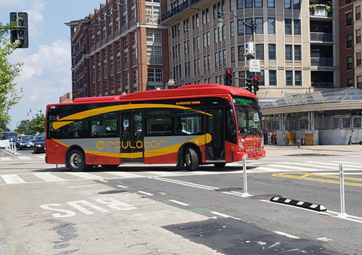
To illustrate how poorly the 14Th St Project was conceived and is being managed, on 2/10/21 DDOT announced it is conducting a study of the 14th Street Bus-Bike lanes from 2/16 thru 4/15 to determine the effectiveness of the project by installing cameras on Circulator Buses which are to use the project’s car free Bus-Bike lanes.   The problem with this study is, because of poor design the Circulator buses don’t/can’t use these lanes Bike-Bus lanes.  Southbound Circulators turning from Irving St. can’t make the tight right turn need to use Bus-Bike lanes, therefore must share the car lane.  Northbound Circulators which most turn left at Columbia Road don’t use the bus-bike lanes which are in the far right lane instead us the car lane which now moves slower.  This poor design defeats the supposed purpose of the project increasing bus times.  Further given the change in traffic patterns due to the pandemic, what use is the study and method?  This is a useless study of a poor design, which DDOT has already concluded is a success.


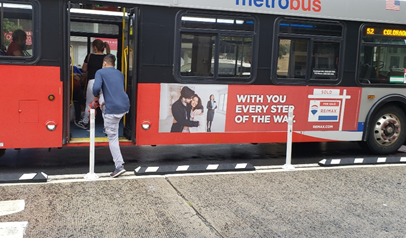
Photo 1: Southbound Circulator turning from Irving St. can’t enter Bus-Bike Lane.


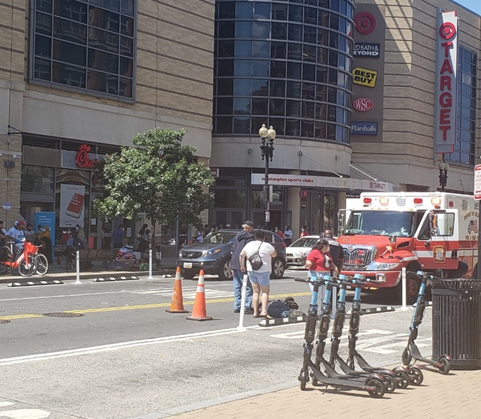
And worst, the 14th St project was implemented by DDOT in a careless and unsafe manner.   DDOT was obviously more concerned with getting the project done quickly than the impact on Black and Brown residents who would be most impacted by the project.  DDOT provided little if any outreach, support signage or traffic control personnel during implementation or coordination with WMATA.  As a result, the Senior Citizen in the photo below was severely injured after tripping over one of the Bus-Bike lane protection barriers.   He was trying to reach a Metro Bus which could not dock at the curb bus stop because of DDOT lane construction issues.  Metro Buses instead of stopping at the curb were stopping a car lane into the street for on and off loading.


Photo 2: Bus-Bike Land Pedestrian Injury. Note the Skip Scooters in the foreground, DDOT’s true constituent.


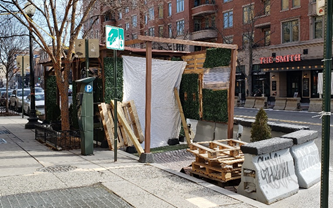
 Photo 3: Poor coordination with WMATA which led to injury shown in photo 2.


Other 14th Project design and implementation failures which particularly impacted Black and Brown residents included:


– Took away parking for Black and Brown residents, while continuing to allow the Circulator and WMAT Express Bus to by-pass their areas.


– Bus-Bike lanes directed Buses into tree canopy resulting in tree destruction.


– Bus-Bike lane pushes WMATA buses closer to curbs exposing Black and Brown pedestrians to bus mass, increased noise and fumes.


– Eliminates or frustrates curb side services to senior building.


What is “Flat White” Urbanism?

“Flat White” urbanism as discussed by planners Amin Yasin and Daniella Fergusson in their article, “Pandemic patios and “flat white” urbanism”, in Plan Canada, Winter 2020,

“is a “flat white” power and legal structure implemented through restrictive covenants, redlining, planning euphemisms, land theft, architecture, bylaws and their enforcement, and choices that smooth over structural issues in favor of aesthetic improvements to the status quo.”

“is an unfettered, “flat white” neoliberal utopia where the imaginary White and able-bodied subjects are prioritized in perpetuity – a mark of a “successful city.””

“in centering Whiteness within planning, Whiteness names a “legacy of injustice” for social dysfunction, while normalizing and idealizing places of white affluence that resulted from the same injustices.”

Yasin and Fergusson’s article speaks of the contradictions and biases “pandemic patios” which closely mirrors the streatery privatization policies embedded in The Vision Zero Enhancement Omnibus Amendment Act of 2020. DDOT’s knee-jerk implementation of these policies as with the 18th Street NW Streatery compounded the confusion and biases inherent in the privatization found in Vision Zero.

Under DDOT’s leadership and our Vision Zero policies the photo on the left represents the acceptable and the right is unacceptable. Why?


“Big Capital Mobility or Uber/Lyft-ing”

In short, DDOT under the disguise of improving bike and pedestrian safety via projected bike lanes and such is through the back door making a major public policy shift toward privatizing public space and transportation, transit by and adopting a business model called “Mobility as a Services” (MaaS) without full public transparency, vetting and assessment of MaaS’ potential impact on racial equity. MaaS is heavily backed by Big Capital: Silicon Valley venture capital, technology and real estate focused hedge funds and Wall Street capital markets via firms such as Uber and Lyft. These entities seek big profits in privatizing public space and transportation as urban areas of optimized for gentrification and what our city calls the “creative class”.


DDOT via its MaaS policies is systematically handing over their responsibilities as a public agency to companies such as Uber and Lyft. This is dangerous because as publicly traded companies Uber and Lyft are beholding to their shareholders and quarterly stock values. Companies who currently not profitable, Uber losses in 2020 was $6.77B. How do they plan to become profitable, becoming a private DDOT/WMATA. Surely, not by ensuring DC’s systems meet a high standard when it comes to racial equity.


The 14th Street project is an example of what happens when DDOT officials prioritize MaaS development over the lives of its residents, especially Black and Brown residents. Community oversight of DDOT is difficult enough imagine when DDOT is completely Uber/Lyft-ed.


DDOT MaaS Privatization Alarms
DDOT pays Lyft approximately $9.6M/year to run our Bikeshare system.

DDOT as a awarded a so-called pilot to CurbFlow to privatize management of DC curb space. A VC ventured backed by former Mayor Fenty, likely skirting procurement rules.

DDOT pays RATP Dev North America (RATP) a company owned by the French government over $40M/yr to run the DC Circulator and Streetcar.

Lyft once owned by venture capital firms, now publicly traded controls and runs DC’s Bikeshare program under contracts worth 10s of millions of dollars.

DDOT Dockless Bike & Scooter MaaS Companies

• HelBiz – An Italian Venture back by VC’s TriPoint Global Equities, LLC, Zhonglu Group

• Jump – A DDOT bike and scooter company was initially back by Silicon Valley Venture Capital firms such as Menlo Ventures, SineWave, Alumni Ventures, SOSV to the tune of over $100M. Today Jump is owned by Uber which acquired for around $200M.

• Lime – now owned by Uber ($170M), Alphabet (Google), Bain Capital, GV. Lime absorbed Jump as part of the deal $510M

• Lyft – Sean Aggarwal (ebay),Floodgate Ventures, Mayfield Fund, IPO General Motors and Fidelity

• Skip – Alexis Ohanian, A Capital, SV Angel
• Spin – Grishin Robotics and CRCM Ventures, Ford($100M)


In conclusion, 2020 has been DDOT’s year of “flat white” urbanism and “Big Capital Mobility Uber/Lyft-ing” using our COVID-19 crisis as a cover for the privatization of our public spaces and transportation systems without honest public debate around the consequences of this MaaS policy shift for racial equity. The 14th Street Project highlights the problems the agency has with the concept of equity, and the bias inherent in DDOT’s approaches. Pushing what happened on 14th Street under the cover of the pandemic to all 8 Wards is not equity.

  •  


Part 1: up-FLUMing & The Detroit Hedge Fund that Eat Adams Morgan


On October 27th of 2020 the Mayor  with the acquiescence of the City Council(with the seeming exception of CM Silverman), and the DC’s Office of the Attorney General (OAG) effectively ceded the planning and development the future of Adams Morgan to two Hedge Funds Friedman Capital (Detroit) and  Wexford Capital via commercial real estate firm Foxhall Partners when they failed to enforce the terms of the $46M Adam Morgan Hotel Tax Abatement.   It’s frightening enough to see a historic neighbor such as Adams Morgan effectively sold-off to hedge funds, but also how impotent our government was when it came to enforcing our laws and protecting our most venerable. 


Hedge Funda limited partnership of investors that uses high risk methods, such as investing with borrowed money, in hopes of realizing large capital gains.


In 2019, The Atlantic did an article on some of the possible dynamics when a hedge fund buys your neighborhood, “When Wall Street Is Your Landlord”.


Next month our city will again address this matter of effectively selling off larger portions of our city neighborhoods to hedge funds when it takes up the Mayor’s (OPs) proposed amendments to our Comprehensive Plan.    The active ingredient of the Mayor’s amendments to the Comp Plan is something called mass up-FLUMing.  In the context of our Comp Plan mass up-FLUMing effectively turns large areas of our city over to hedge funds to plan and development, as they are the only ones have the capacity to benefit from mass  upFLUMing.   And as we learned from the case of Adams Morgan Hotel once up-FLUMing occurs our city’s political and legal infrastructure WILL NOT be able to project existing residents and provide effective legal oversight, basically ending self-government in these areas.   This is especially true in DC  predominantly Black neighborhoods the primary targets of up-FLUMing.


up-FLUMing – in DC this is the process of modifying the city’s Comp Plan in order to radically change our  city’s Future Land Use Map (FLLUM) to increase development density in city neighborhoods.  Typically, allowing the development of large/tall mix use luxury projects in formally low and moderate density residential neighbors while minimizing or eliminating current resident’s say in the development process.


The Mayor, Council Members such as Cheh, Nadeau and others, developers and many members in the so-called Smart Growth movement argue that these Comp Plan amendments which turn large portions of our city to hedge funds will result in greater numbers of affordable housing and a more racially equitable city.  And will make our city more financially sound as revenues from hedge fund controlled development trickles down residents. We know from the former Donatelli Project at Hill East neither affordable housing or trickle down results, in fact the opposite.


For persons such as myself, the above Smart Growth profeers are ridiculous on their face. As the intent of hedge funds is to capture all the trickle have as much public investment (tax abatements, TIFs, public land dispositions) as possible funned through the coffers. 


In fact, I believe CFO Dewitts’ suddenly announced resignation affirms my view that up-FLUMing large portions of the city for hedge funds via Comp Plan amendments WILL NOT trickle down nor produce affordable housing as the smart growth crew proffers.  So, he is getting out of dodge before the chickens come home to roost.   In short, Dewitt believes the Council will raid the city’s reserves in the coming budget season to force a trickle down that the city’s edge fund focused development policies do not produce. This raiding will cause the city’s bond rating on Wall street to drop down from AAA-ish ratings. And he does not want that on his record and his watch, so he’s getting out of dodge.


The Council unlike the CFO is more vulnerable to citizen up roar given the city had nearly a $600M budget surplus this past year, our Apartheid-like racial, economic, and  social system that COVID-19 exposed and the coming eviction crisis which will occur as edge fund backed projects will need to horde vacant units to maintain prices.  And while our Mayor fiddles with a solution that depends on keeping everyone drunk and high while we can make it through recovery in 2022/3.


To better understand the potential impact of mass up-FLUMing, we can study how a Detroit began consuming Adams Morton in 2010. 


William


WTF: Developer sells city financed homeless shelter for $883/sqft


—–Original Message—–
From: whj@melanet.com
Sent: Monday, March 14, 2016 6:13pm
To: “<columbia_heights@yahoogroups.com&gt;” <columbia_heights@yahoogroups.com&gt;, “southcolumbiaheights@yahoogroups.com” <southcolumbiaheights@yahoogroups.com&gt;, “AdamsMorgan@yahoogroups.com” <AdamsMorgan@yahoogroups.com&gt;
Cc: “Mendelson, Phil (COUNCIL)” <pmendelson@dccouncil.us&gt;, “‘abonds@dccouncil.us’” <abonds@dccouncil.us&gt;, “Nadeau, Brianne K. (Council)” <bnadeau@dccouncil.us&gt;, “Kenner, Brian (EOM)” <brian.kenner@dc.gov&gt;
Subject: WTF: Developer sells city financed homeless shelter for $883/sqft

I knew this “market rate” housing talk as B.S. a few years ago when a developer speculated in the Columbia Heights market with a high end luxury condo project and it crashed. The city steps in with $5.7M in taxs abatements and a few weeks later the building is flipped by the developer for a record $670/sqft. That’s not “market rate” housing, that’s cross between money laundering and a ponzi scheme. But check this sh$t out.

The city just enabled a developer to sell a homeless shelter for $883/sqft..

In 2012 the Gospel Rescue Ministries a faith-based homeless shelter which opened in 1906 and operated with District Government contracts considers filing for bankruptcy but then decides instead to sell the shelter. So in February 2013, The Rock Creek Property Group comes along and buys the shelter for $5.95 million, or $192 per square foot from Gospel Rescue to build high end “market rate” residential units.

In June of 2014 the city comes back and offers Rock Creek a 20 year lease at $1.28 million, or $39.77 per square foot to convert back to a homeless shelter.

Rewind to December 2011, the city gives developer Brian Friedman a $46M tax abatement to build a hotel in Adams Morgan. The deal is rushed through Council claiming a hardship need or the deal with fail. Deal fails any way. In 2013 Friedmen leverages the abatement to find a new partner. The partner comes in from New York takes a piece of the deal from Brian and Freidman Capital.

Fast forward to 2016. Rock Creek signs a new lease for the old now new and improved Gospel Rescuse homeless shelter with the City as part of the Mayor’s “Bill 21-620, Homeward DC Omnibus Approval of Facilities Plan for Short-Term Housing for Persons Experiencing Homelessness Act of 2016”.

On March 10th 2016, Rock Creek flips the shelter and lease to guess who? Brian of Freidman Capital for $883/sqft or about $28.5M.

So did the city effectively pay Freidman Capital $46M to pay $28M to the Rock Creek Property Group so Rock Creek could convert luxury rentals back to a homeless shelter that the city could have bought 3 years ago as a shelter for $3M or so?

Could this be the same city that is supposedly so broke and concerned about the city’s debt cap that it can’t fully fund the New Communities Human Capital programs and acquire build first sites? Instead, everything needs to be funded by converting public housing to “market rate” housing? Of course not, right.

It surely is not the same city that is proposing to send $55M to build a Basketball Practice Facility for billionaires because the billionaires can only afford to pay $5M. What kind of “market rate” is that?

I’m sure it’s me, but what my government calls saving the homeless by closing DC General and fostering economic development, sounds and smells like a tax payer money laundering ponzi scheme. But WTF, we going to but a cap on it.

William

Rock Creek Property Group cuts ties after converting Chinatown site into homeless shelter
www.bizjournals.com/washington/breaking_ground/2014/06/in-chinatown-high-end-residential-is-out-and.html

In Chinatown, high-end residential is out and shelter is in
www.bizjournals.com/washington/breaking_ground/2016/03/rock-creek-property-group-sells-chinatown-site.html?ana=e_du_pap&s=article_du&ed=2016-03-14&u=oSmDycT7fYztxKl8aVEQckJ2JXJ&t=1457984186&j=71395762

Tax abatements, exemptions to face new scrutiny in D.C.
www.bizjournals.com/washington/print-edition/2011/09/30/tax-abatements-exemptions-to-face-new.html

Gospel Rescue Ministries Files For Bankruptcy To Keep Its Buildings
www.washingtoncitypaper.com/blogs/housingcomplex/2012/05/30/gospel-rescue-ministries-files-for-bankruptcy-wont-lose-its-buildings/

UDR closes on View 14 sale
www.bizjournals.com/washington/blog/2011/06/udr-closes-on-view-14-sale.html

Tax break approved for Adams Morgan hotel
www.bizjournals.com/washington/blog/2010/12/tax-break-approved-for-adams-morgan.html

FW: Pimping Millennials & Screwing The Low Income


—–Original Message—–
From: whj@melanet.com
Sent: Tuesday, March 24, 2015 10:36am
To: “columbia_heights@yahoogroups.com” <columbia_heights@yahoogroups.com&gt;, “southcolumbiaheights@yahoogroups.com” <southcolumbiaheights@yahoogroups.com&gt;, “AdamsMorgan@yahoogroups.com” <adamsmorgan@yahoogroups.com&gt;
Cc: “‘abonds@dccouncil.us’” <abonds@dccouncil.us&gt;, “Alexander, Yvette (COUNCIL)” <yalexander@dccouncil.us&gt;, bnadeau@dccouncil.us, “Cheh, Mary (COUNCIL)” <mcheh@dccouncil.us&gt;, “‘kmcduffie@DCCOUNCIL.US’” <kmcduffie@dccouncil.us&gt;, “Evans, Jack (COUNCIL)” <jackevans@dccouncil.us&gt;, “‘dgrosso@dccouncil.us’” <dgrosso@dccouncil.us&gt;, “Mendelson, Phil (COUNCIL)” <pmendelson@dccouncil.us&gt;, “esilverman@dccouncil.us” <esilverman@dccouncil.us&gt;, “Allen, Charles (COUNCIL)” <callen@dccouncil.us&gt;, “‘Kenner, Brian (EOM)'” <brian.kenner@dc.gov&gt;
Subject: Pimping Millennials & Screwing The Low Income


From Lofts to Micro Units, watch the Public’s Balance Sheet. To paraphrase an old saying, “If you find yourself stuck in a hole and you want to get out, first stop digging.” If DC as a city really wants to address our affordability crisis, we, the Mayor, and Council have to first find the courage to stop digging the affordability crisis hole. In this case “stop digging” means ending DMPED’s practice of structuring land disposition deals which manipulate public subsidies, often low income, to build overpriced so-called luxury housing transferring public wealth to a hand full of families. These deals have become “Balance Sheet” Brothels in which low and moderate income families get screwed through discrimination and Millennials pimped for their on-demand incomes while wealth building capacity is being siphoned from both.

This DMPED structured “Balance Sheet Brothel” is best illustrated in the Hill East land disposition deal recently signed by the Mayor and previously unanimously approved by the City Council. If we look at the deal’s Term Sheet and extract the Balance Sheet data you will see that under DMPED’s deal the developer will invest $10 in equity and in 2 years at the end of construction will hold $21M in equity on their Balance Sheet. That is a 2.1M% return on investment in 2 years. Further, the deal is structured to provide the developer with an implicit government guarantee via low income housing bonds. Because of this, the developer assumes minimal risk and collects $8M in fees for their trouble. You don’t have to have a MBA in finance to know if a $10 investment can produce $8M in fees and $21M in equity in 2 years that all the Brothel’s in DC have NOT been closed down. And some pimping and screwing is going on.

The Mayor and Council can’t honestly approve this Hill East deal as structured and claim to be working to address housing affordability and developing a path to the middle class. This deal and other DMPED deals are structured to do the opposite. Just follow the balance sheet. A high priced so called luxury micro-unit rental or pimped out dorm room is design to transfer future wealth/equity into present day income for the luxury developer, whose development is being made possible/subsidized by public spending financed by long term public debt. When the average Millennial rents one of these units disposal income which could be used for equity producing investments or stimulus into the overall or neighborhood economy instead flows to the hands of a few. If a developer wants to do this take the risk and a Millennial want to rents these fine, but it should not be propped up by my Government using public land, low income housing subsidies and discriminatory housing policies. Government can no longer tell limited options to deal with the affordability crisis, while continuing to do deal like Hill East.

It’s time to stop digging and clean-up the DMPED Brothel. Then we can seriously address our affordability crisis and invest for the future. The con of touting education reform as an investment in our children’s future, while mortgaging that future to subsidize luxury units is ethically and morally wrong. And our government needs to get out of this business. I know the world’s oldest profession is not going anywhere, but it should not be the bases of community and economic development in this city. We need real and health economic growth. I know we have the Mayor and Council who can do this, let’s close the Brothel.
.


William