Bill B23-0736 Comprehensive Amendment Act of 2020 crafted by DC’s Office of Planning (OP) under Director Trueblood structurally amounts to “racial redlining” often associated with 1930s -1970s. The active ingredient of OP’s structural redlining instead of relying on horizontal placement of lines on a map, instead relies on less visible vertical impacts, “vertical redlining”. To better understanding “vertical redlining” inherent in B23-736, would require the production of 3D and 4D maps something OP such provide.
There is a certain irony in the public debate around B23-736 in that the bill’s strongest supporters, “pass it now!”, speak mostly about the ills of historic racial redlining while supporting a bill which reestablishes redlining via the Comp Plan. Some of this is rooted in ignorance, some lazy politics and some just plain greed. For clarity, the primary purpose of racial redlining and its antecedents was to structurally separate Blacks and some others from wealth and the tools of wealth building, not so much to Segregate Blacks from Whites. The dynamics around Black home ownership, mortgage lending and government regulations are most often cited in the story of racial redlining.
By 2004, city leaders figured out how to use zoning PUDs, city tax and disposition subsidies via public-private partnerships and public corporations to implement a ad hoc system of modern day redlining, all wrapped in Mayor William’s 100K New resident policy. Neighborhood residents and developers were incentivized and pushed by the city leaders to support larger and more dense projects. Such projects were not financeable in most neighborhoods so developers required/demanded more and more public subsidy. In response the city shifted subsidy from projects which would support low and moderate income residents progress, primarily Black and Latino, to facilitate targeted new residents primarily White. And when it came to housing, incentivizing a product beyond the price point of many Black resident to obtain a mortgage or related business loans. This was cemented after the 2008 crash.
The taller and denser, the vertical nature of the project, the less likely that it would be accessible to DC’s Black residents, particularly in neighborhoods a few years earlier would have been accessible. B23-0736 seeks to make this ad hoc redlining progress structural.
The image below provides a good illustration of this vertical racial redlining. While the ladders seem to be design to reach the same location, the distance between the rungs is increased on the ladder to the right. B23-736 changing of Comp Plan maps, up-FLUMing and definitions increase distance between the rungs when comparing the ladders.
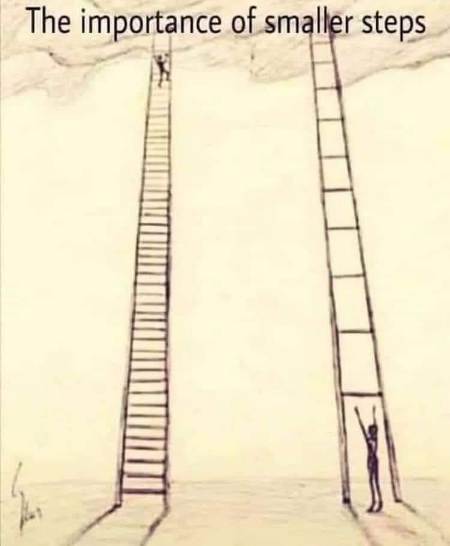
In DC, the wealth and income status of Black residents is inversely proportional to neighborhood project density beyond the levels facilitated and envisioned by the 2006 Comp Plan. B23-0736 directs the flow of public and private capital and resources into vertical strata typically beyond the reach of DC Black residents, thus “Vertical Redlining”. For examples of this vertical redlining” look no further than the Park Morton NCI, Howard Hospital, McMillan, and Union Market projects.
The proponents of Bill B23-0736 Comprehensive Amendment Act of 2020, OP and other so-called Smart Growthers proffer that the overall increase in the production of affordable housing units over the next 25 years is adequate compensation for the racial impacts of “vertical redlining”.
We will explore this proffer in DC’s Comp Plan & Vertical Redlining III, racial equity and affordable housing for DC’s Black Families.
William